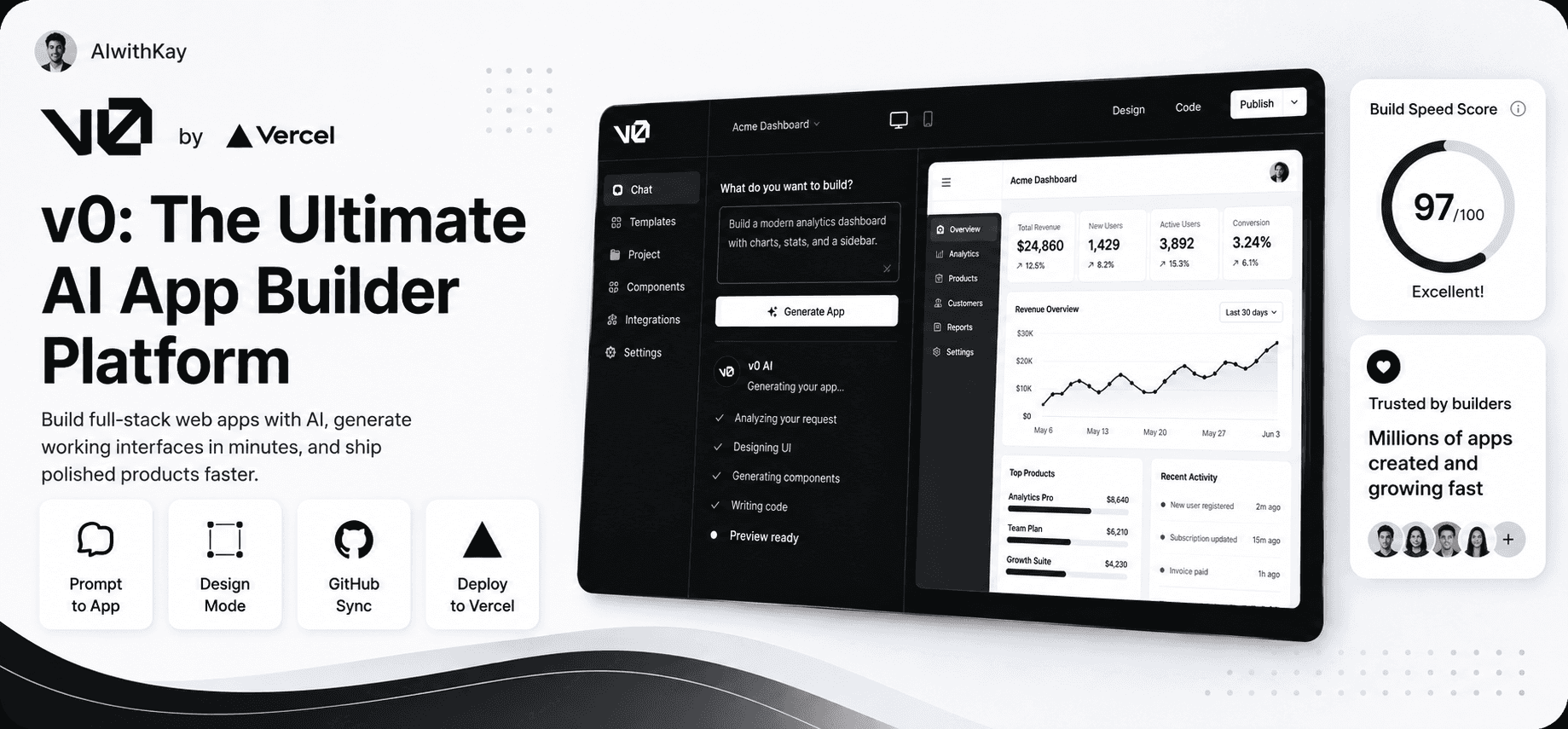
When ChatGPT first launched, most of the industry was focused on what it could write. Vercel CEO Guillermo Rauch noticed something narrower and, it turned out, more immediately useful: AI was extraordinarily good specifically at writing React and Tailwind code. He built a tool around that one observation, launched it as a research preview in September 2023, and within a year, more than 3 million builders had used it to generate over 100 million applications.
v0 turns a chat prompt into a working web app, complete with a live preview, editable code, and one-click deployment to Vercel. It leans on modern React and Next.js conventions, syncs directly with GitHub, and can even import an existing Figma design as a starting point. Because it's built by the same team behind Vercel and Next.js, the code it generates tends to look like something a frontend developer would actually write, not throwaway scaffolding you'll rewrite from scratch.
This review covers what v0 is genuinely good at versus where it struggles, what it costs once you're past the free credits, and how it compares to broader app builders like Lovable and Bolt.new.
Short answer: v0 is worth it if you're a developer or technical team that wants AI to draft clean, production-shaped UI code fast. It's less suited to non-technical users who want a fully guided, backend-included app builder, that's closer to what Lovable or Bolt.new are built for.
Quick Verdict
Metric | Detail |
|---|---|
AIwithKay score | 7.9/10 |
Scale | 3M+ builders, 100M+ applications generated in under a year, ARR approaching $50M and doubling year-over-year |
Best for | Developers and technical teams wanting AI-generated UI code that's close to production-ready |
Starting price | Free ($5 in monthly credits), or $20/month (Premium) |
Free plan | Yes, enough to get a real feel for the product before committing |
Bottom line | The code quality genuinely leads the category for React/Next.js output, but it's more UI-focused than full-app builders, and the Hobby-to-Pro pricing cliff hits sooner than expected |
What Works Well / What To Watch
What works well:
Clean, production-shaped code. Generated React and Next.js output follows real conventions, TypeScript types, accessibility attributes, responsive design, that a developer would actually write by hand, not disposable scaffolding.
Deep Vercel integration: one-click deploy and GitHub sync fit naturally if you're already in a Vercel-based workflow, no extra setup required.
Figma import lets you start from an existing design instead of describing a whole interface from scratch in a prompt.
A real free tier: $5 in monthly credits is enough to genuinely test whether the code quality and workflow fit before you pay anything.
Built by the team behind Next.js itself, which shows up specifically in how closely the generated code follows accepted React best practices.
What to watch:
Credits burn fast on complex prompts. Larger generations and premium models eat into the monthly allowance quickly, worth watching if you're iterating heavily.
More UI-focused than full-app: v0 is less oriented toward wiring up a complete backend and database than broader builders like Lovable or Bolt.new.
Can hallucinate or loop on very complex, custom logic changes to an existing component, sometimes costing more prompting time than just writing the change by hand would have.
The pricing cliff from the free Hobby tier to Pro is steep and arrives suddenly, features that feel essential for a real production site, like custom domain bandwidth and team collaboration, require the paid plan.
v0 is still young enough as a standalone product that its public review footprint is thinner than more established coding tools, worth a short trial of your own rather than leaning entirely on secondhand ratings.
What Is v0?
Guillermo Rauch founded Vercel in 2015 (originally as Zeit, rebranding in 2020) and is also the creator of Socket.IO, a widely-used real-time communication library, credentials that matter here because they're the reason v0's output code looks like it was written by someone who deeply understands modern frontend conventions, not a generic AI wrapper bolted onto a chat interface.
The insight behind v0 was narrow and specific: rather than trying to build a general-purpose AI coding assistant, Rauch noticed that large language models were unusually good specifically at React and Tailwind syntax, patterns with enough public training data and enough internal consistency that AI could generate genuinely usable starting points, not just rough drafts. Launched as a research preview in September 2023, v0 found product-market fit fast enough that by 2024, more than 3 million builders had generated over 100 million applications through it, a pace that put it among the most-used AI coding tools in the world within its first year.
By 2026, that early traction had turned into real, growing revenue: annualized revenue approaching $50 million and paid usage doubling year over year, according to Vercel's own disclosures, growth that's kept pace with, rather than following, the broader AI app-builder category's expansion.
Key Features
Chat-to-app. Describe an app or component in plain English and get a working, styled implementation back, not just a rough mockup.
Live preview. See the generated app running immediately, rather than reading a code snippet you have to run yourself to evaluate.
GitHub sync. Push generated code straight to a repository for real version control, not a one-off export.
Figma import. Bring in an existing Figma design as a starting point, available on paid plans.
One-click deploy. Publish directly to Vercel and go live in seconds once you're happy with a generation.
Design mode. Visually edit generated components with a live preview instead of only working through prompts.
How v0 Performs In Practice
No paid v0 account was run specifically for this review, worth saying plainly. What follows is grounded in v0's own documented output conventions and Vercel's published usage data, not a summary of other sites' star ratings.
The code-quality claim is specific and technical rather than vaguely positive, and it's verifiable in v0's own generated output: components follow real React and Next.js conventions, TypeScript types, accessibility attributes, responsive patterns, closely enough that they're usable as real starting points, not requiring a full rewrite. That traces directly back to Rauch's own framing of the product: built by the team behind Next.js itself, tightly scoped to what LLMs are already unusually good at.
The limitation worth planning around: complex, custom logic changes to an already-generated component can send the AI into a loop, burning credits and time that would sometimes have been faster to just hand-code directly. That's a real, specific limitation, v0 is strongest as a first-draft and prototyping tool, not necessarily for iterating deeply on intricate custom logic.
A practical way to work within that limitation: use v0 to generate the initial component and get the layout, styling, and basic interactions right, then move complex custom logic changes into your own editor or a general-purpose coding assistant once you're past the prototyping stage. Treating v0 as the fast first 80% rather than expecting it to carry a project through intricate, bespoke logic changes is the workflow that gets the most out of what it's actually built to do.
v0 Pricing in 2026
Verified against v0's official pricing and Tools item research the day this was written.
Plan | Price | What You Get |
|---|---|---|
Free | $0/month | $5 in monthly credits |
Premium | $20/month | $20 in monthly credits, Figma imports, v0 API access, higher upload limits |
Team | $30/user/month | $30 in credits per user, plus daily free credits |
Business | $100/user/month | Higher usage limits for larger teams |
Enterprise | Custom | Through Vercel's sales team |
Is it worth the price? For an individual developer prototyping UI regularly, Premium at $20/month is a reasonable trade against the hours saved drafting components from scratch, especially if you're already deploying through Vercel. For a team, the jump to $30-100/user/month is steep enough that it's worth confirming your team will use v0 heavily enough to justify it over a cheaper, more general coding assistant.
v0 vs Competitors
Tool | Best For | Starting Price | Key Differentiator |
|---|---|---|---|
v0 | Developers wanting clean, production-shaped React/Next.js code fast | Free | Highest code quality for React/Next.js specifically, deep Vercel integration |
Lovable | Non-technical users wanting a fully guided app builder, backend included | Free tier, paid from $25/month | Broader full-stack app generation, more approachable for non-developers |
Bolt.new | Teams wanting fast full-stack prototypes with enterprise backing | Free tier, paid plans available | Broader app-building scope than v0's UI focus, backed by a Microsoft Azure partnership |
Lovable is the better fit if you're not a developer and want a more guided, backend-included app-building experience, v0 assumes more technical familiarity with the code it generates. Bolt.new competes more directly on full-stack scope, wiring up backends and databases more readily than v0's UI-first focus, at the cost of the specific code-quality polish v0's tight Next.js integration provides. v0's real edge is for developers specifically: cleaner starting code, in exchange for less hand-holding on the full application beyond the interface.
The simplest way to pick between the three: if you can read and modify React code yourself, v0's output quality gives you the fastest legitimate starting point. If you can't, or don't want to, Lovable's more guided, less code-literate-dependent flow will get you further without needing a developer's help along the way.
Who v0 Is Best For
Best for:
Developers and technical teams who want AI to draft clean, usable UI code fast rather than a rough mockup to rewrite.
Anyone already working inside the Vercel/Next.js ecosystem who wants generation, deployment, and version control in one flow.
Teams that have an existing Figma design and want to convert it into working code quickly.
Skip it if:
You're not technical and want a fully guided app builder that also handles backend and database setup, Lovable or Bolt.new are closer to that job.
Your work involves frequent, complex custom logic changes to generated components, the looping/hallucination risk is a real time cost there.
You need a broader, framework-agnostic tool rather than one tightly optimized for React, Next.js, and Tailwind specifically.
Final Verdict: Is v0 Worth It?
v0's 100 million generated applications in under a year is a genuinely fast adoption curve, and it traces back to a narrow, correct insight: AI is unusually good at React and Tailwind specifically, and a tool built tightly around that strength beats a more generic AI coding assistant for UI work. The code-quality praise in reviews is specific and technical, not vague enthusiasm.
The honest caveats are scope and pricing structure, not code quality. v0 is a UI-generation tool first, not a full-stack app builder, and the free-to-paid pricing cliff arrives sooner than the sticker price suggests once you need custom domains or team features. For a developer who wants a genuinely strong first draft of an interface, that tradeoff is well worth it.
Curious to see how it performs?
Try
v0 by Vercel
Now
GOT ANY QUESTIONS LEFT?
Is v0 worth it in 2026?
How much does v0 cost?
Is v0 better than Lovable or Bolt.new?
Can v0 build a complete app with a database?