In 2004, two MIT graduate students noticed something that seems obvious now and wasn't then: buyers didn't want to be interrupted by ads, they wanted helpful information. Brian Halligan and Dharmesh Shah built a whole company, and coined the term "inbound marketing," around that one observation. Twenty years later, HubSpot serves more than 200,000 customers and has woven AI (branded Breeze) through nearly every part of the platform they built.
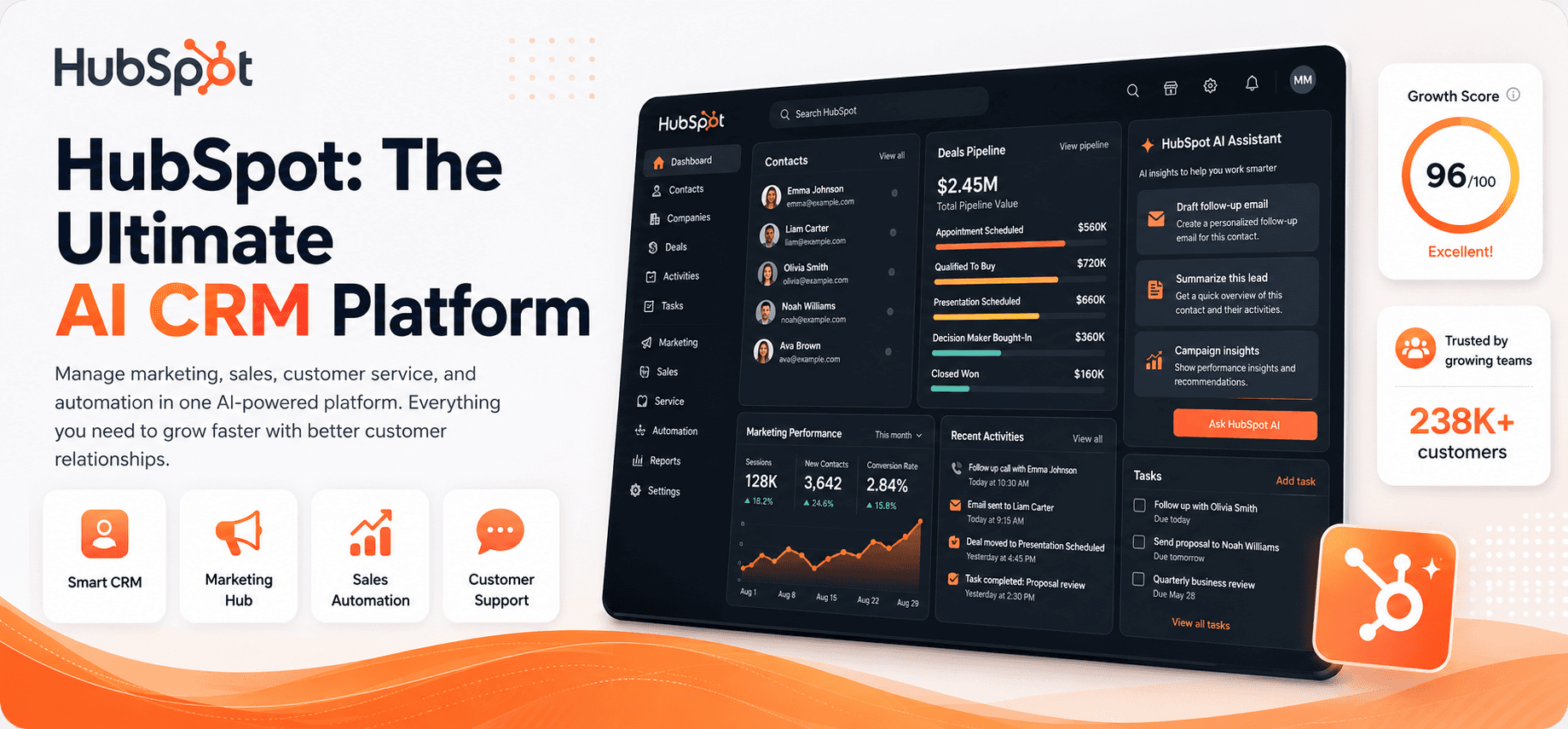
HubSpot is a CRM-first platform bundling marketing, sales, and service tools into one system, with Breeze AI features layered across all of them to draft emails, score leads, and summarize customer records. The pitch is one system of record instead of a patchwork of point tools, marketing, sales, and support all sharing the same contact history instead of living in separate silos that need manual syncing.
This review covers what the free CRM actually gets you, why the jump to Professional catches so many growing teams off guard, and the specific onboarding and billing costs worth reading before you commit.
Short answer: HubSpot is worth it if you want marketing, sales, and service on one shared contact record and you're realistic about the cost once you outgrow Starter. The free CRM is genuinely usable for years; Professional's pricing jump is the number that actually decides this purchase.
Quick Verdict
Metric | Detail |
|---|---|
AIwithKay score | 8.2/10 |
Scale | 200,000+ customers worldwide, one of the largest CRM platforms by adoption |
Best for | Growing businesses that want marketing, sales, and service unified on one contact record |
Starting price | Free, or $7/month per seat (Starter) |
Free plan | Yes, and genuinely usable long-term, not a stripped trial |
Bottom line | The free CRM and Starter tier are real value; the jump to Professional is steep and comes with mandatory onboarding fees most homepage pricing doesn't make obvious |
What Works Well / What To Watch
What works well:
The free CRM is genuinely usable long-term. Plenty of small teams run on it for years before ever paying, not a 14-day trial dressed up as free.
Everything connected: marketing, sales, and service data share one contact record, so Breeze AI features can act on full customer history instead of a fragment of it.
A large ecosystem: hundreds of marketplace integrations and a big community of agencies who already know the platform well.
AI woven throughout, not bolted onto one feature. Breeze touches content drafting, lead scoring, and customer summaries across the whole platform.
Adopted at real scale across every business size, from solo founders to enterprise marketing departments, a broad base that's hard to fake at 200,000-plus customers.
What to watch:
The jump from Starter to Professional is steep: $7/seat to $800/month for 3 seats, a specific, well-documented pricing cliff, not a vague gripe.
Professional and Enterprise both require mandatory one-time onboarding fees, $3,000 and $7,000 respectively, on top of the monthly subscription.
Pricing scales with your marketing contact list size, which can surprise a growing list even if your seat count hasn't changed.
Support responsiveness, cancellation friction, and unexpected charges are recurring, well-documented complaints, worth reading the cancellation terms before you sign an annual contract (see below).
The sheer number of features and settings can overwhelm a team that only wanted basic email marketing, the platform's breadth cuts both ways.
What Is HubSpot?
Brian Halligan and Dharmesh Shah met at MIT's Sloan School of Management, and in 2006 turned an observation about changing buyer behavior into a company: HubSpot, built around the idea that helpful content earns attention better than interruptive ads. Halligan coined "inbound marketing," and the two co-authored a book on the concept and built the INBOUND conference (now called UNBOUND) into one of the industry's biggest marketing events.
That founding idea, that a company's marketing, sales, and service should work from the same understanding of a customer rather than three disconnected departments, is still the actual product architecture two decades later. HubSpot's CRM sits at the center, and Marketing Hub, Sales Hub, Service Hub, and CMS Hub all read from and write to that same contact record instead of syncing between separate databases.
The Breeze AI layer, HubSpot's most recent major addition, extends that same philosophy: because the AI has access to the full customer history across every department, it can draft a follow-up email, score a lead's likelihood to convert, or summarize a support ticket with more context than an AI bolted onto a single-purpose tool would have.
Key Features
Breeze AI agents. AI assistants that draft content, qualify leads, and answer customer questions using data from across the whole CRM, not one isolated tool.
Unified CRM. Marketing, sales, and service data live in one contact record, eliminating the manual syncing a patchwork of point tools requires.
Email and automation. Build automated sequences and workflows without needing a developer to configure them.
Landing pages and forms. Build and publish marketing pages and lead-capture forms natively, without a separate website tool.
Reporting dashboards. Track campaign performance and sales pipeline in real time from the same platform.
Large app marketplace. Hundreds of integrations to connect the rest of your existing tech stack.
How HubSpot Performs In Practice
No paid HubSpot account was run specifically for this review, worth saying plainly. What follows is grounded in HubSpot's own published pricing structure and documented product behavior, not a summary of what other review sites report.
The unified contact record is the actual reason teams stick with HubSpot past the free tier: because Breeze AI and every Hub (Marketing, Sales, Service) read from the same customer history, a follow-up email, a lead score, and a support summary all draw on the full picture instead of a fragment one tool happens to have. That architectural choice, not any single flashy feature, is what the product's 200,000-plus customer base is actually paying to keep.
The part worth stress-testing before you sign anything is the Professional pricing cliff and its onboarding fee, both mandatory, both easy to underestimate from the homepage's $7 headline. Support responsiveness and cancellation friction are also well-documented enough, especially once a team is locked into an annual Professional contract, that it's worth reading HubSpot's own cancellation terms directly before you commit, not after.
A practical way to stress-test this before signing an annual Professional contract: ask HubSpot's sales team directly for the full, itemized first-year cost, subscription plus onboarding fee plus any add-ons you know you'll need, in writing, before you commit. That single document resolves most of the sticker-shock that shows up after the fact, since the confusion usually traces back to a verbal quote that didn't include every line item.
HubSpot Pricing in 2026
Verified against HubSpot's official pricing and Tools item research the day this was written. Pricing varies by which Hub (Marketing, Sales, Service, CMS) and bundle you choose; figures below reflect the core CRM Suite tiers.
Plan | Price | What You Get |
|---|---|---|
Free | $0/month | Up to 2 users, 2,000 email sends/month, basic forms and live chat with HubSpot branding |
Starter | $7/month per seat | 1,000 marketing contacts, 500 HubSpot Credits, basic automation and ad management |
Professional | $800/month (includes 3 seats, $45/month per additional seat) | 2,000 marketing contacts, unlimited automation, advanced personalization. Requires a $3,000 one-time onboarding fee |
Enterprise | $3,600/month (includes 5 seats, $75/month per additional seat) | 10,000 marketing contacts, advanced features, custom reporting. Requires a $7,000 one-time onboarding fee |
The number that actually decides this purchase isn't the $7 headline, it's whether your team's real needs stop at Starter or require Professional's automation depth. That gap, $7 to roughly $845/seat-equivalent in the first year once onboarding is included, is worth modeling honestly against your actual contact list size and automation needs before you commit.
Is it worth the price? For a small team that mainly needs email marketing and basic CRM, Starter is genuinely good value and the free tier can carry you even longer. For a team that needs real workflow automation and advanced personalization, Professional's cost is defensible against hiring additional headcount, but budget for the onboarding fee as a real, mandatory line item, not an optional extra.
HubSpot vs Competitors
Tool | Best For | Starting Price | Key Differentiator |
|---|---|---|---|
HubSpot | Growing businesses wanting marketing, sales, and service unified | Free | Deepest cross-department data sharing, AI acts on full customer history |
Salesforce | Enterprises needing maximum CRM customization | $25/user/month | More configurable at enterprise scale, steeper learning curve and implementation cost |
ActiveCampaign | Small businesses wanting strong email automation on a budget | $15/month | Sharper focus on email/marketing automation, thinner native sales and service tooling |
Salesforce wins for large enterprises that need deep, custom configuration and have the implementation budget and team to support it, at the cost of HubSpot's faster time-to-value and gentler learning curve. ActiveCampaign is the sharper choice if your actual need is email marketing automation specifically and you don't need HubSpot's full sales and service Hub breadth. If your bottleneck is workflow automation specifically rather than the CRM itself, it's also worth comparing against a dedicated automation platform like Zapier, which HubSpot integrates with directly rather than replaces. HubSpot's real edge is the middle ground: more unified than a point tool, faster to stand up than Salesforce.
Worth being specific about that middle ground: teams that outgrow ActiveCampaign usually outgrow it because they need sales pipeline and service ticketing on the same contact record as their email campaigns, exactly the gap HubSpot fills. Teams that outgrow HubSpot usually do so on customization depth, at which point Salesforce's steeper implementation cost starts to make more sense relative to what a fully custom sales process actually needs.
Who HubSpot Is Best For
Best for:
Growing businesses that want marketing, sales, and service on one shared contact record instead of syncing between separate tools.
Teams that will genuinely use Breeze AI across content drafting, lead scoring, and customer summaries, not just one isolated feature.
Businesses starting on the free CRM that have a realistic growth path toward Starter or Professional as needs increase.
Skip it if:
You only need basic email marketing and the Professional tier's automation depth isn't something you'll actually use.
Your budget can't absorb the mandatory onboarding fee alongside the monthly cost when you're ready for Professional or Enterprise.
You need Salesforce-level customization for a complex enterprise sales process, HubSpot's flexibility has real limits at that scale.
Final Verdict: Is HubSpot Worth It?
HubSpot's twenty-year run from an MIT dorm-room observation about buyer behavior to a 200,000-customer CRM platform holds up because the core architecture, one shared contact record across every department, still solves a real problem most growing businesses actually have. Adoption at that scale, across every business size from solo founders to enterprise marketing departments, is hard to fake.
The honest catch is the Professional pricing cliff and the mandatory onboarding fees that come with it, real costs that the free tier and Starter's low headline price don't prepare you for. Model your actual contact list size and automation needs against that jump before committing, and read the cancellation terms directly while you're at it. For a team that genuinely needs the unified platform, HubSpot remains one of the more complete options in the category.
Curious to see how it performs?
Try
HubSpot
Now
GOT ANY QUESTIONS LEFT?
Is HubSpot worth it in 2026?
How much does HubSpot actually cost?
What are the biggest complaints about HubSpot?
Is HubSpot better than Salesforce?