
If you buy through a link on this page, we may earn a commission, at no extra cost to you.
In Poland, foreign films are dubbed by a single narrator called a "lektor." One flat, monotone voice reads every character's lines over the original audio: the hero, the villain, the eight-year-old, all of them. No emotion, no gender switch, just one tired-sounding man reading a script on top of a movie.
Mati Staniszewski grew up watching movies like that. It bothered him enough that in 2021 he and his childhood friend Piotr Dabkowski started tinkering with speech AI on a hack weekend, trying to build something that could dub a film in a voice that actually matched the character. That weekend project is now ElevenLabs, a company that raised $500 million at an $11 billion valuation in February 2026 and says its voice technology is used by 41% of Fortune 500 companies.
A big valuation doesn't tell you whether a tool is right for you, though. So let's get into what ElevenLabs actually does, what it costs today, and who should (and shouldn't) hand it their credit card.
ElevenLabs is an AI voice and audio platform that turns typed text into speech realistic enough to fool most listeners, and it has grown into a full audio suite covering voice cloning, dubbing, music, transcription, and conversational AI agents, all under one account.
Short answer on whether it's worth it: if you make video, podcasts, courses, or anything with a script that needs a voice, yes, and it's still the best-sounding option available. If your work lives entirely on the page, like a blog or a newsletter, you're likely paying for a lot of capability you'll never open.
That split matters more than most reviews let on. A lot of ElevenLabs coverage online is written by YouTubers reviewing it for YouTubers, which is fair, that's the biggest use case, but it also means the "is it worth it" question rarely gets asked from the point of view of someone who isn't already making video every week.
This review covers the voice quality, the features beyond text to speech, real pricing verified today, how it stacks up against Murf, Play.ht, and Speechify, and exactly who should sign up and who should skip it.
How we put this review together
This is built from ElevenLabs' own site and pricing page, checked the day this was written, cross-referenced against its G2 rating (4.5/5 from 1,140+ reviews) and its Trustpilot rating (3.1/5 from 1,079+ reviews, worth noting that gap, more on it below). We also pulled recurring themes from independent writers and creators who've actually paid for a plan, including a candid writer's take on whether it's worth it that we've linked throughout. Where a figure is a reported experience rather than something we could verify ourselves, we've said so.
ElevenLabs review: quick verdict
Metric | Detail |
|---|---|
User ratings | 4.5/5 on G2 (1,140+ reviews) · 3.1/5 on Trustpilot (1,079+ reviews) |
Best for | Creators, podcasters, e-learning teams, dubbing/localization, and developers building voice into a product |
Price range | Free to start, paid plans from $6/month |
Bottom line | The most realistic AI voice on the market, but the credit system needs real budgeting once you move past the entry tier |
Our one-line verdict: ElevenLabs sounds better than anything else in this category, and the price of admission is learning to respect the credit meter before it surprises you.
What we like and what needs attention
What works well:
Voice quality that's genuinely hard to tell from a human recording, especially with the newer Eleven v3 model
One account covers text to speech, voice cloning, dubbing, music, transcription, and conversational agents, not just narration
5,000+ voices across 70+ languages, plus the option to clone your own voice or design one from a text prompt
Fast enough to get a usable voiceover in minutes, no audio engineering background needed
A genuinely usable free plan you can test before paying anything
What to watch:
Credits don't roll over between months, and multiple independent users report real-world usage running roughly 2 to 3 times what the plan page implies once failed takes and regenerations are counted
Costs climb quickly once you're producing video regularly rather than the occasional voiceover
It can mispronounce brand names, acronyms, and unusual proper nouns, which means retakes that also cost credits
Support is chatbot-first, and the gap between its G2 score and its Trustpilot score is driven mostly by billing and downgrade complaints, not voice quality complaints
If your content lives entirely on the page, you're paying for a lot of platform you'll never touch
What is ElevenLabs?
ElevenLabs is a London-based AI voice and audio company, founded in 2022 by Mati Staniszewski and Piotr Dabkowski. It started as a text-to-speech tool built to solve one specific problem, dubbing that actually sounds like the character speaking, and has since expanded into a genuine all-in-one audio platform.
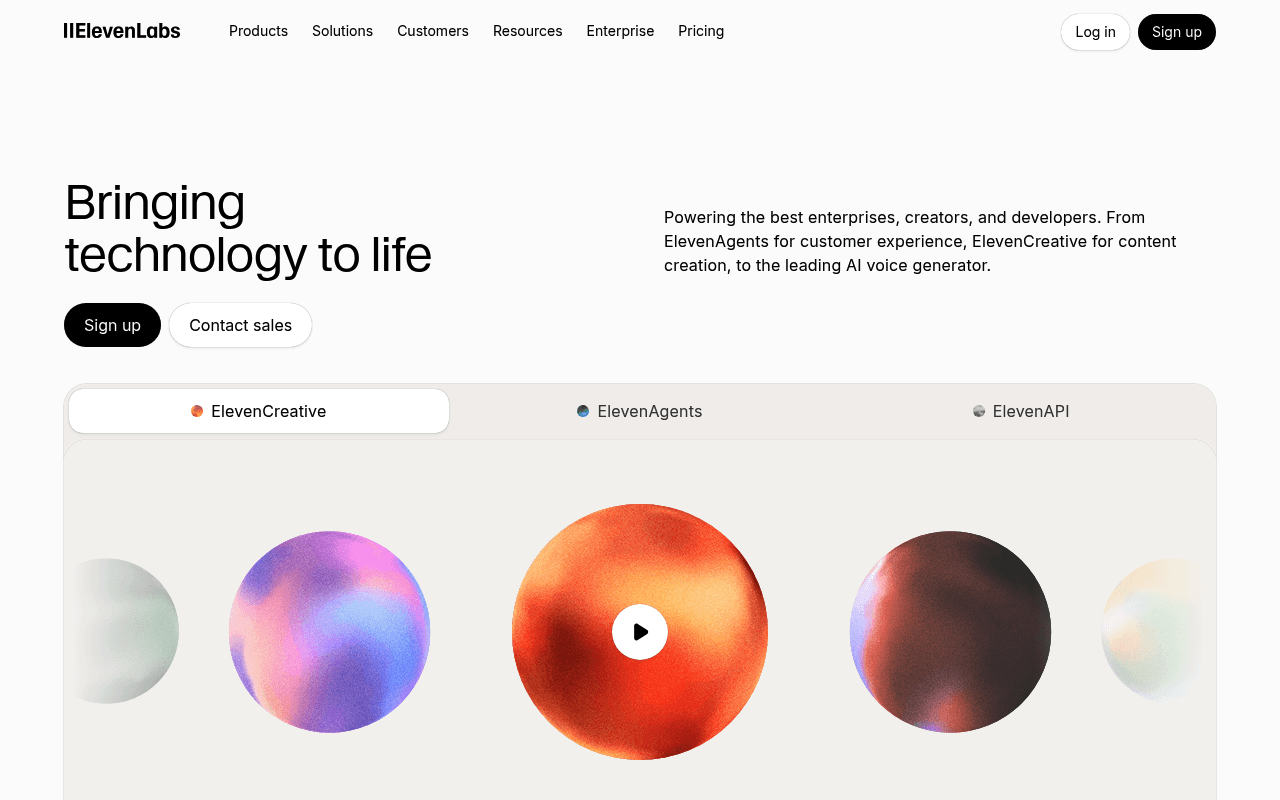
The ElevenLabs homepage, positioning the platform as full-stack voice AI rather than a single text-to-speech tool.
Today the product line includes ultra-realistic text to speech, instant and professional voice cloning, AI-generated music and sound effects cleared for commercial use, near-perfect transcription, and ElevenAgents, a system for deploying conversational AI agents that can hold real phone, chat, or WhatsApp conversations. A full developer API ties all of it together for teams building audio into their own apps.
The growth has been fast by any standard. ElevenLabs closed a $500 million funding round at an $11 billion valuation in February 2026, and its voice technology is reportedly used by 41% of Fortune 500 companies. The customer list stretches well beyond media and entertainment names like Disney, NVIDIA, Salesforce, and Epic Games to include the Washington Post, TIME, HarperCollins, Deutsche Telekom, and Revolut, spanning publishing, telecoms, and finance rather than just video production.
It's also the voice layer inside other tools you may already use, including Artlist's AI voiceover feature.
Key features
Ultra-realistic text to speech. Type a script, pick from 5,000+ voices across 70+ languages, and adjust stability, emotion, and pacing. The Eleven v3 model can be directed with plain-language instructions, like telling it to sound tired or to whisper a specific line, rather than fiddling with sliders.
Voice cloning. Clone your own voice from a short sample, design a completely new voice from a text description, or browse thousands of community voices in the Voice Library for any project. Instant cloning takes minutes; professional cloning takes longer but produces a more accurate, more expressive replica.
ElevenAgents. Build and deploy conversational AI agents that handle real phone calls, chats, emails, and WhatsApp messages in 70+ languages, with low latency and built-in compliance guardrails for regulated industries like healthcare and finance.
AI music and sound effects. Generate studio-quality music tracks and custom sound effects in any style, trained on licensed data and cleared for commercial use, useful for background scoring without a separate stock-music subscription.
Dubbing Studio. Translate and re-voice a video into another language while keeping the original speaker's tone and cadence, instead of just subtitling over it or replacing it with a flat, generic voice.
Scribe, ElevenLabs' speech-to-text model. Transcribes audio with claimed accuracy around 98%, including speaker labels and character-level timestamps, available through the API for teams building their own transcription workflows.
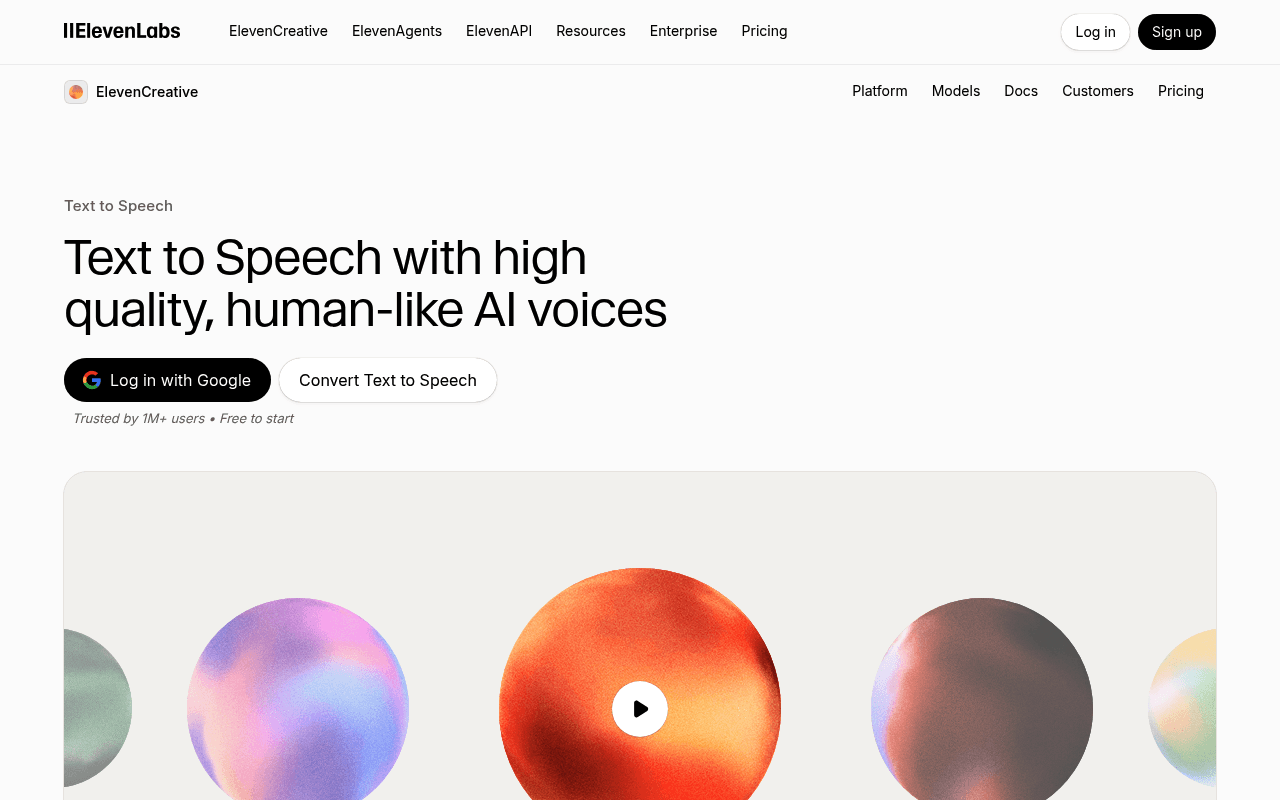
The Text to Speech workspace, where a script goes in and a chosen voice reads it back.
Is voice cloning on ElevenLabs safe?
This is a fair question to ask before you upload anyone's voice, including your own. ElevenLabs requires users to confirm they own or have explicit consent to clone a given voice, and its Professional Voice Cloning tier adds a verification step before training even starts. The platform also runs "no-go voices" safeguards designed to detect and block cloning attempts targeting public figures and political figures without authorization, particularly around election periods.
That matters beyond ethics. At least a dozen US states now have voice cloning laws on the books, including Tennessee's ELVIS Act, so documenting consent in writing isn't optional caution, it's increasingly a legal requirement if you're cloning a voice for client work, ads, or a public campaign.
How ElevenLabs actually performs
Think of ElevenLabs less like a single voice actor and more like a very talented one who bills by the word, and occasionally insists your brand name is pronounced like a French pastry.
Across G2, Trustpilot, and independent write-ups, the voice quality itself is the one thing almost nobody disputes. Reviewers consistently describe the newer models as close to indistinguishable from a real recording in short clips, and creators using it for YouTube narration, audiobooks, and course content report it holding up across full-length projects, not just demo snippets. On G2, the most-cited themes in 1,140+ reviews are ease of use, quality, and speed, with roughly a third of reviewers also flagging it as expensive, so the pattern isn't hidden if you read past the star rating.
Where the experience gets rockier is the credit meter. One independent reviewer, a professional writer who tested ElevenLabs specifically for text-first work rather than video, put it plainly: "real-world costs run 2 to 3x what the plan page suggests" once failed generations and regenerations are counted against the monthly allowance. She burned roughly 65,000 of her 100,000 monthly Creator-tier credits with moderate use, and concluded that for someone whose content lives on the page, "you're paying for capabilities you won't use."
That's a genuinely useful data point, and it lines up with a pattern visible in ElevenLabs' own review scores: the 1.4-point gap between its G2 rating and its Trustpilot rating is driven almost entirely by billing and downgrade complaints, not complaints about how the voices sound. So what does this mean for you? If you're producing regular video, podcast, or course content, budget for a tier above the one you think you need, and treat the advertised credit counts as optimistic rather than exact.
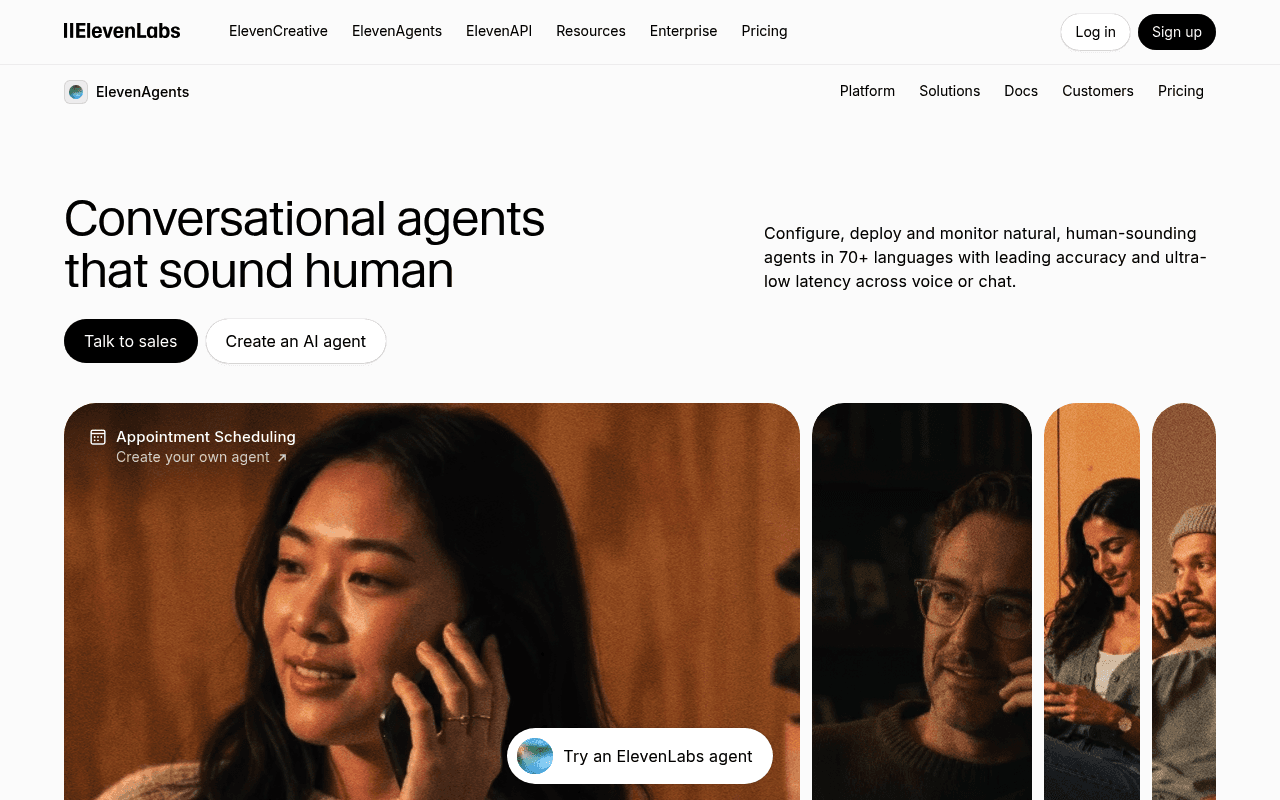
ElevenAgents, the conversational AI agent side of the platform, built for phone, chat, and WhatsApp support use cases rather than narration.
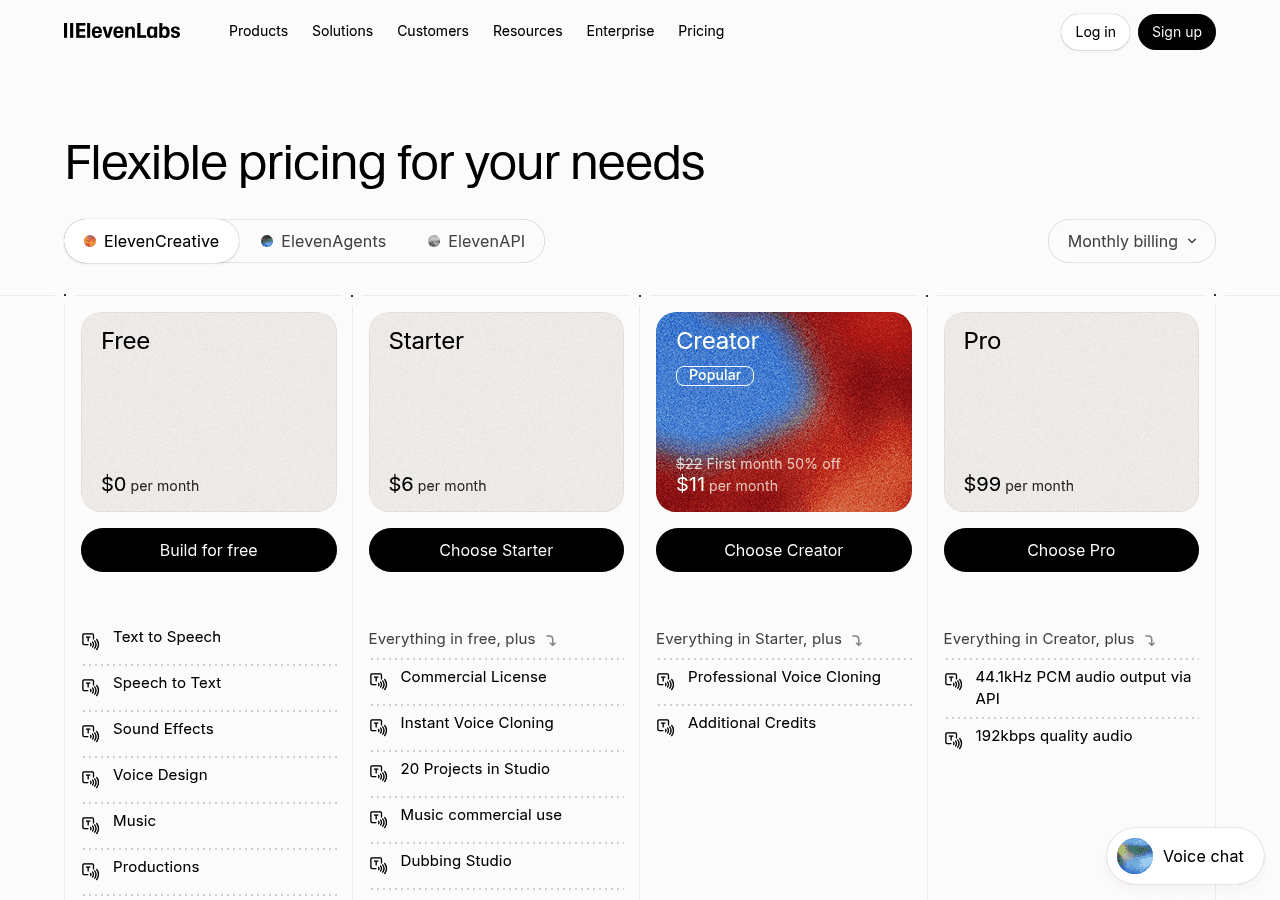
ElevenLabs' pricing page, verified the day this review was written. Pricing changes fast in this category, confirm current numbers on ElevenLabs' own pricing page before buying.
Credits roughly track characters generated for standard text to speech, so a longer script simply costs more, and a failed take that you regenerate costs again on top of the first attempt. Faster, lower-latency models tend to be cheaper per character than the most expressive ones, which is part of why real-world usage is so hard to predict from the plan page alone.
The free plan is genuinely enough to judge voice quality before you commit a card. Where it gets tight is exactly what the section above described: because real usage tends to run higher than the sticker credit count, most regular creators are more comfortable on Creator at $22 a month than on Starter, even though Starter technically unlocks commercial use at $6.
Is it worth the price? For anyone producing voice content regularly, yes, the quality gap over cheaper tools is large enough to justify it. For a one-off project or a text-only workflow, the free plan or a single month of Starter will tell you everything you need to know without a bigger commitment.
ElevenLabs vs the competition
Tool | Best for | Starting price | Key difference |
|---|---|---|---|
ElevenLabs | Realistic voice, cloning, dubbing, agents, and music in one platform | Free, Starter $6/mo | Widest audio suite and the most natural-sounding voices we found |
Murf | Voiceover paired with a built-in slide/video editor | Free, Creator $29/mo ($19/mo annual) | Better for teams building presentations, not just raw audio |
Play.ht | Converting large content libraries to audio | Free, Creator around $39/mo | Strong for bulk narration, voice quality trails ElevenLabs |
Speechify | Personal listening and accessibility, not production voiceover | Free, Premium about $11.58/mo annual | Built for reading things back to you, not for publishing finished audio |
If you want voiceover bundled with an editor, Murf is worth comparing. If you're converting a large back catalog of written content to audio at volume, Play.ht is built for that specific job. Speechify is really a different product, an accessibility and reading tool, not a voice generator for publishing.
Where ElevenLabs pulls ahead is breadth and quality together: it's the only one of the four that also does voice cloning, dubbing, music, and conversational agents at a genuinely competitive level, not just narration.
Price alone makes Murf and Speechify look cheaper on paper, but neither replaces what you'd need ElevenLabs for if your project involves cloning a specific voice, dubbing into another language, or standing up a phone agent. Compare them on the job you actually need done, not just the number on the pricing page, and the gap narrows or disappears depending on the use case.
Who it's best for (and who should skip it)
Best for: YouTubers and podcasters who need consistent narration, e-learning and course creators localizing lessons into multiple languages, businesses building phone or chat agents for support and sales, publishers producing audiobook or article-to-audio versions of their catalog, and developers who want voice, transcription, or dubbing behind an API rather than a finished consumer app.
Skip it if: your content is text-only, like a blog or a newsletter, and you have no near-term plans to add audio or video, you make one video a year and a single human voiceover would be cheaper for that volume, or you're not willing to track credit usage closely enough to avoid a mid-month surprise when the meter runs out.
If you're deciding between an AI voice and an AI avatar for talking-head video, it's worth reading our HeyGen review or our Synthesia review alongside this one, both pair well with an ElevenLabs voice track under the hood. If you also need transcription and a timeline editor rather than just voice generation, our Descript review covers that side of the workflow.
Final verdict
ElevenLabs earns its reputation. The voice quality is the best we found in this category, the platform now covers far more than text to speech, and a $500 million funding round at an $11 billion valuation says the market agrees this isn't a passing trend. The rough edges are real too: credits that don't roll over, real-world usage that runs ahead of the plan page, and support that's harder to escalate than the price tag would suggest.
If your work involves a script and a voice, in video, audio, or a live agent, ElevenLabs is still the one to beat in 2026. If your work stays on the page, this is one AI subscription you can safely skip for now, and that's fine, not every AI tool needs to be for everyone.
The most useful thing you can do before paying anything is start on the free plan, run your actual script through it, and watch how many credits it eats. That fifteen minutes will tell you more about whether it's worth it than any review, including this one.
Want to hear the difference yourself before committing? Try ElevenLabs' free plan and test a script in your own voice or one from the library, no card required to start.
Curious to see how it performs?
Try
ElevenLabs
Now
GOT ANY QUESTIONS LEFT?
Is ElevenLabs free to use?
Why do ElevenLabs credits run out faster than expected?
Is ElevenLabs better than Murf or Speechify?
Is voice cloning on ElevenLabs legal and safe to use?


