AI Tool Comparision
Kay Tried Multiple AI Tools for SEO for a Year, But Only These 7 Stood Out

If you buy through a link on this page, we may earn a commission, at no extra cost to you.
Somewhere around month four of testing AI tools for SEO writing, a pattern showed up. The tools that actually helped weren't the ones that wrote the most words. They were the ones that made me look at a real ranking page before I typed a single sentence.
I've spent the better part of a year running real SEO work, drafts, briefs, rewrites, audits, through a long list of AI tools. Some earned a permanent tab in my browser. Most got opened once, tested honestly, and quietly closed.
The seven that stood out are ChatGPT, Claude, Frase, Surfer SEO, Clearscope, the Semrush AI Toolkit, and KoalaWriter. Each one earned its spot for a different job, not because one AI writer beats all the others at everything.
This is for anyone who has typed "best AI SEO tool" into Google at midnight and gotten back forty near-identical listicles. Verified pricing, real screenshots, and the honest catch on every single pick, no exceptions.
How I Judged a Year of AI Tools for SEO
Quick honesty note, because trust is the whole point of this site. This wasn't a lab experiment with a control group. It was the version most solo writers, freelancers, and small teams actually live: real drafts, real keyword briefs, real "why did this page never rank" afternoons.
Four questions decided who made this list and who didn't:
Does it ground itself in something real? A tool that only knows what its training data remembers is guessing. A tool that pulls the actual top-ranking pages for your keyword is working from evidence.
Does the output need an edit, or a teardown? Anything that read like it needed a full rewrite before publishing didn't make the cut, no matter how fast it typed.
Is the pricing honest? Every price below was checked on the tool's own live pricing page this week, not lifted from a comparison chart written eight months ago.
Does it survive a real deadline? A tool that's brilliant in a demo and unusable at 4:45pm on a Friday doesn't count.
One more thing worth saying upfront. Google's own guidance is blunt about generative AI content. It can help with research and structure. Using it to mass-produce low-value pages can violate Search's spam policies. None of the seven tools below exist to help you skip that warning. The good ones exist to help you clear the actual bar: useful, accurate, and worth a reader's time.
One more shift changed who belongs on this list at all. A 2026 SparkToro and Similarweb analysis found that 68% of U.S. Google searches now end without a click, up from 60% two years ago, and AI Overviews alone appear on more than one in five queries while cutting click-through by nearly 60% when they show up. Writing a good page is no longer the whole job. Knowing whether it actually got read, by a person or by an AI answer, is now part of the same workflow. That's why a pure measurement tool earned a spot on a "writing tools" list this year.
The 7 at a Glance
Tool | Best for | Starting price (verified July 2026) |
|---|---|---|
ChatGPT | Fast ideation and first drafts | Free; Plus $20/month |
Claude | Long-form drafts that don't sound like AI | Free; Pro $17/month billed yearly |
Frase | Turning SERP research into a brief and a draft | $39/month billed yearly |
Surfer SEO | Optimizing a draft against real ranking pages | $49/month billed yearly |
Clearscope | Simple grading for non-SEO writers | $129/month |
Semrush AI Toolkit | Tracking AI Overview and chatbot visibility | $99/month add-on (needs a Semrush plan) |
KoalaWriter | SEO-native drafts for niche and affiliate sites | $9/month |
1. ChatGPT: Best for Fast Ideation and First Drafts
The tool almost everyone already has open in another tab.
ChatGPT is where most SEO writing sessions start, and for good reason. Type a rough topic and it hands back an outline, five headline options, and a first pass at an intro faster than opening a blank document ever will. For meta descriptions, FAQ drafts, and turning a bullet list of notes into readable paragraphs, it's still the fastest tool on this list.
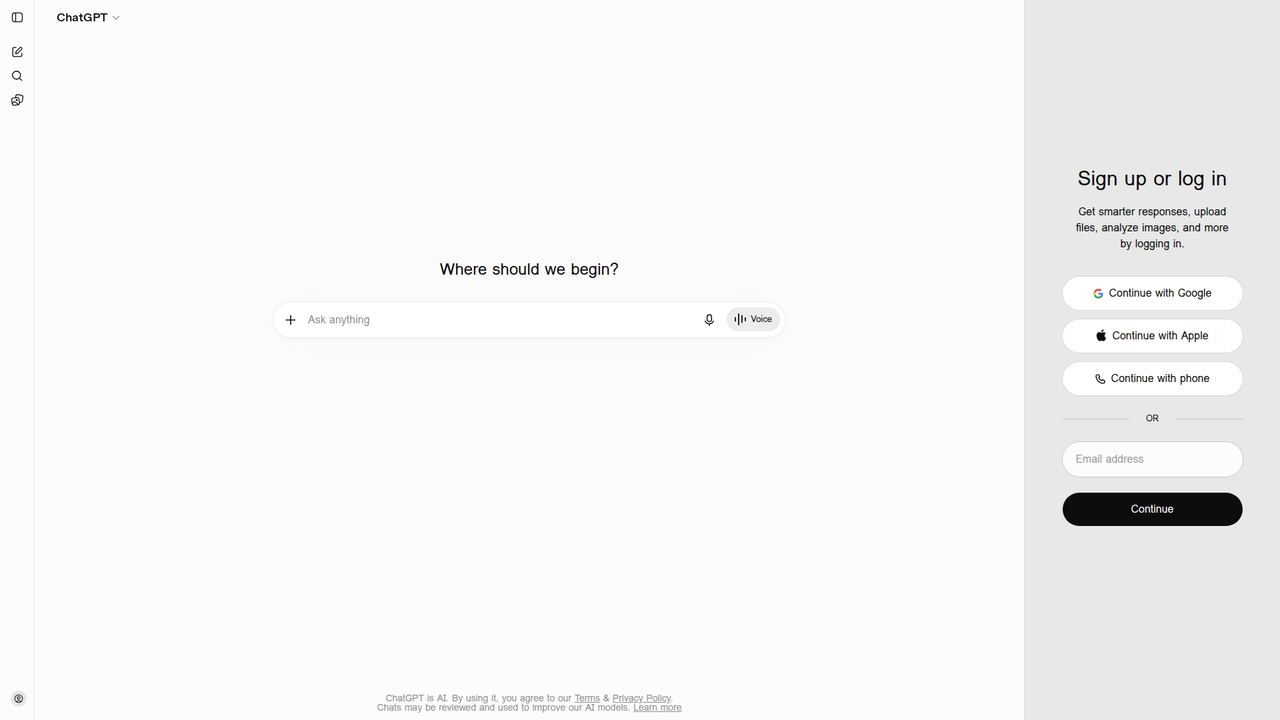
As of July 2026, ChatGPT's free tier is ad-supported, Go runs $8/month, Plus is $20/month with GPT-5.5, Deep Research, and Agent Mode, and two paid Pro tiers sit above that at $100 and $200 a month for heavier research and longer context. Most SEO writing does not need the $200 tier.
The honest catch: ChatGPT doesn't know what's actually ranking for your keyword right now unless you tell it or turn on browsing. Left alone, it will cheerfully hand you 800 words on "the importance of quality content in today's digital landscape," the exact sentence this entire site was built to make illegal. That's the "prompt-to-publish" failure mode that makes AI content forgettable. Pair it with a real optimizer (picks 4 and 5 below) before you publish, not after.
2. Claude: Best for Long-Form Drafts That Don't Sound Like AI
The one writers reach for when the brief actually matters.
Claude's real advantage over ChatGPT for SEO work isn't a single feature, it's the prose. Give it a detailed brief and a style note, and it holds tone and structure across a genuinely long article better than most alternatives, without sliding into the repetitive rhythm that gives AI writing away. That matters more for SEO than people admit, since Google's helpful-content guidance explicitly rewards pages with a point of view, not just topic coverage.

Pricing as of July 2026: free with real daily limits, Pro at $17/month billed annually ($20 month-to-month), and Max plans starting at $100/month for 5x or 20x the usage. Team seats run $20 to $25/month per person.
The honest catch: Claude has the same blind spot as ChatGPT. Nothing about it knows your competitors' headings or what a real SERP looks like today. It's the best drafting engine on this list, not a research tool, and Pro's usage caps can feel tight if you're drafting daily.
3. Frase: Best for Turning Research Into a Brief (and a Draft)
The tool that reads the competition before you write a word.
Frase's whole pitch is closing the gap between "what should this article cover" and "here's a draft." Point it at a keyword and it pulls the top-ranking pages, extracts the headings, stats, and questions they actually cover, and builds a brief automatically. From there it can draft directly inside that brief, scored against SEO and AI-visibility signals as you go.
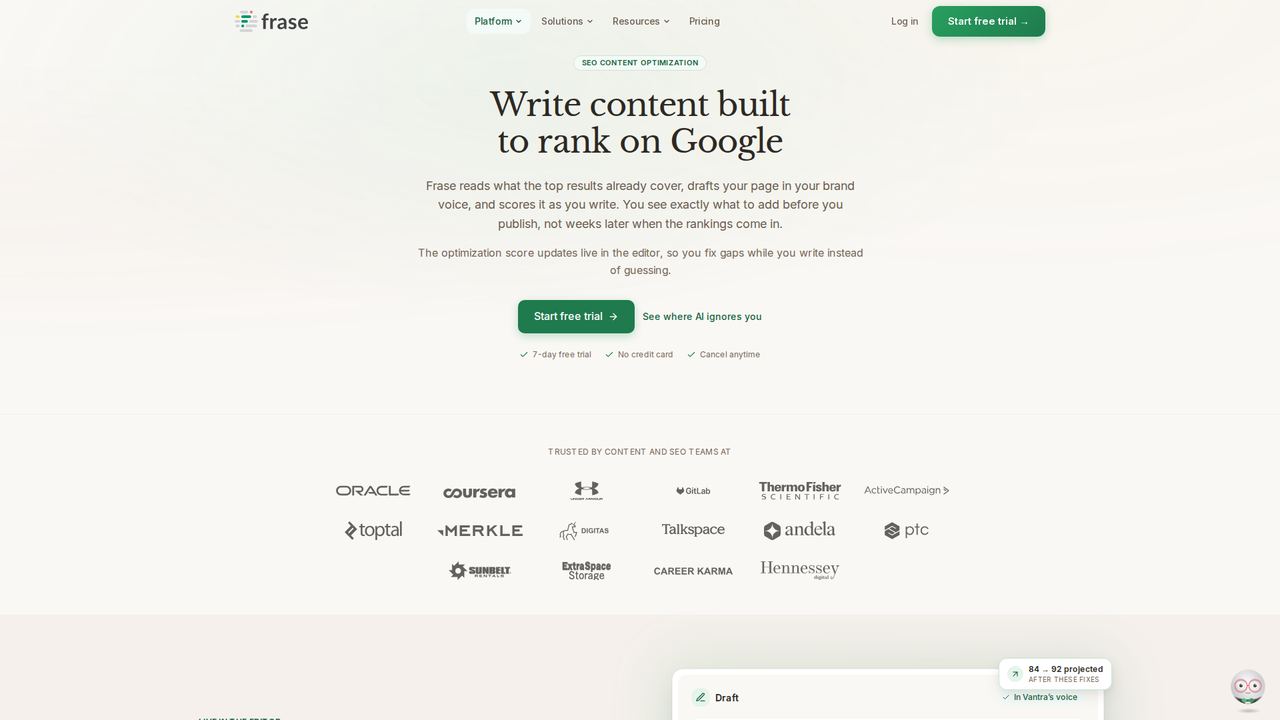
As of July 2026, Starter is $39/month billed yearly ($49 month-to-month) for one site, Professional is $103/month ($129 monthly) for three seats and five sites, and Scale runs $239/month ($299 monthly) for agencies managing up to ten domains.
The honest catch: a Frase brief is only as good as the pages it's copying from. If the current top 10 for your keyword are all thin and repetitive, Frase will happily hand you a brief for a thin, repetitive article. Read the brief with judgment. Don't just fill every suggested heading because the tool suggested it.
4. Surfer SEO: Best for Optimizing a Draft Against Real Ranking Pages
The one that tells you exactly what a page is missing, in real time.
Surfer's Content Editor is still the sharpest tool on this list for one specific job: taking a draft that already exists and showing you, section by section, what the pages actually ranking for that keyword have that yours doesn't. Word count, headings, related terms, and internal linking suggestions, all scored live as you type.
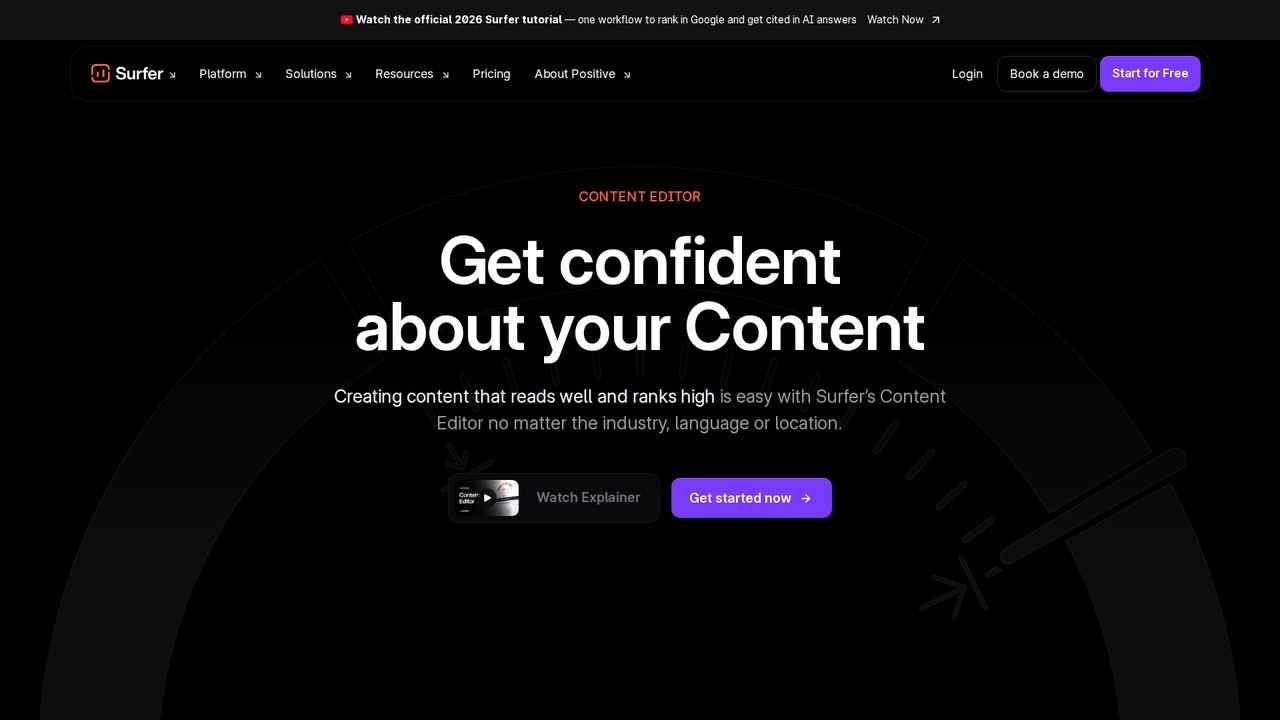
As of July 2026, Discovery starts at $49/month billed yearly for 120 documents a month, Standard is $99/month, Pro (the plan Surfer itself recommends) is $182/month with multi-platform AI-visibility tracking across ChatGPT, Perplexity, and Gemini, and Peace of Mind runs $299/month for unlimited documents.
The honest catch, and it's the same one every "AI ruined SEO" complaint is usually really about: Surfer scores content, it doesn't judge it. Chase the number instead of the reader and you'll get a technically optimized page stuffed with every related term the tool suggested and no reason for a human to finish reading it. Use the score as a checklist, not a finish line.
5. Clearscope: Best for Simple Grading Non-SEO Writers Can Use Alone
An A to F grade any writer can understand without an SEO briefing.
Clearscope does one thing and keeps it deliberately simple: grade a piece of content from F to A++ against what's actually ranking, inside a clean editor a freelance writer with zero SEO background can pick up in ten minutes. No dashboards to learn, no jargon to translate first, and nobody has to learn what "entity coverage" means just to hit publish.

As of July 2026, Essentials is $129/month for 50 tracked prompts and 20 monthly drafts, Business is $399/month with 300 tracked prompts, and Enterprise is custom-priced with SSO and crawler whitelisting.
The honest catch: it's the most expensive entry point on this list by a wide margin, and it only grades, it doesn't draft. If you're a solo blogger watching every dollar, Frase or Surfer's lower tiers do more of the job for less. Clearscope earns its price once you've got several writers who aren't SEO specialists and need one number they can trust without a training session.
6. Semrush AI Toolkit: Best for Checking Whether Any of This Actually Worked
The one that isn't a writing tool at all, and made the list anyway.
Every tool above helps you write or optimize a page. None of them tell you what happens after you hit publish, in the world of AI Overviews, Google AI Mode, ChatGPT, and Perplexity answers where a growing share of searches now end. The Semrush AI Toolkit tracks exactly that: whether your brand or your content is actually getting cited in AI-generated answers, and how you stack up against named competitors doing the same.
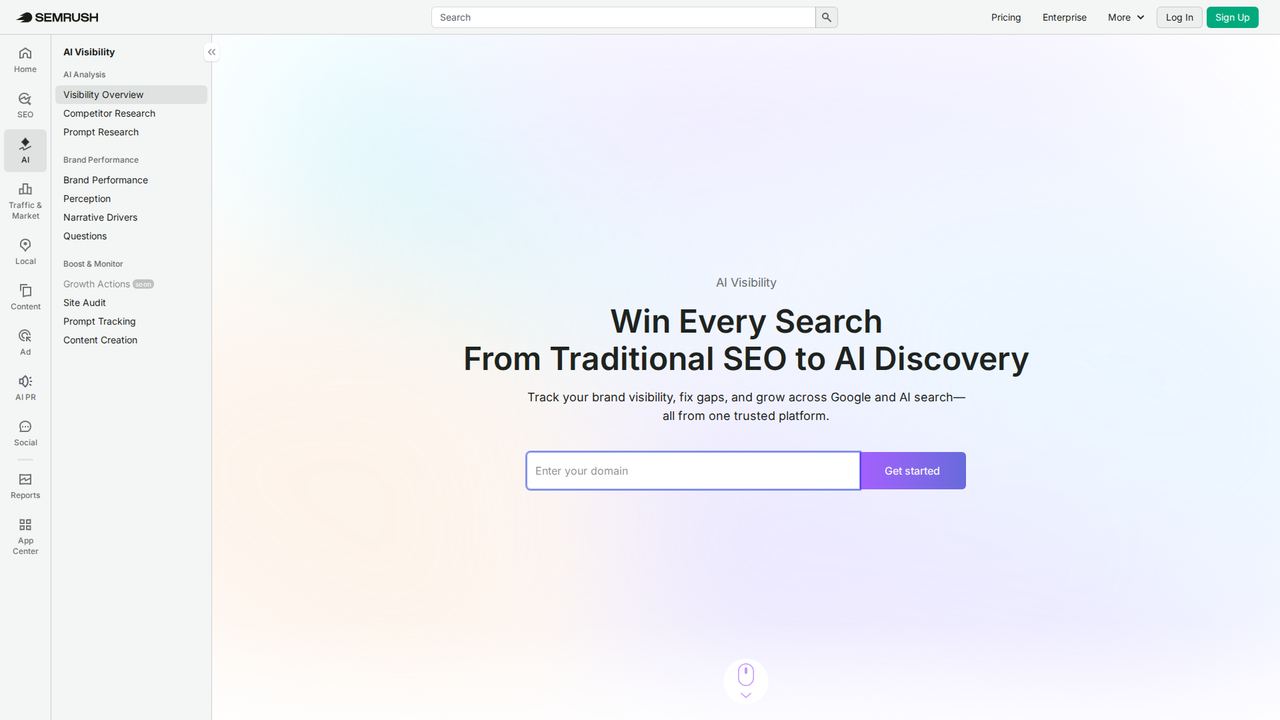
As of July 2026, the AI Toolkit runs $99/month as an add-on for one domain and 25 tracked prompts, on top of an existing Semrush plan (Pro starts around $139.95/month). It's also bundled into Semrush One packages starting near $165 to $199/month billed yearly, which raise the tracked-prompt limits and add the rest of Semrush's SEO suite.
The honest catch: this only pays off if you're already a Semrush subscriber, or willing to become one. It writes nothing and optimizes nothing itself. It's the measurement layer sitting on top of everything else on this list, which is exactly why it stood out, not despite being different from the other six, but because of it.
7. KoalaWriter: Best SEO-Native Drafting Tool for Niche and Affiliate Sites
The cheapest tool on this list that still checks the SERP before it writes.
KoalaWriter, built by Koala AI at koala.sh, is the one tool here that tries to do Frase's research step and ChatGPT's drafting step in a single pass, purpose-built for SEO from the ground up. Point it at a keyword and it reads the current top-ranking pages in real time, then drafts a full article structured around what's actually working, complete with automatic internal linking across your existing site and, for product roundups, live Amazon pricing and review data pulled in automatically.
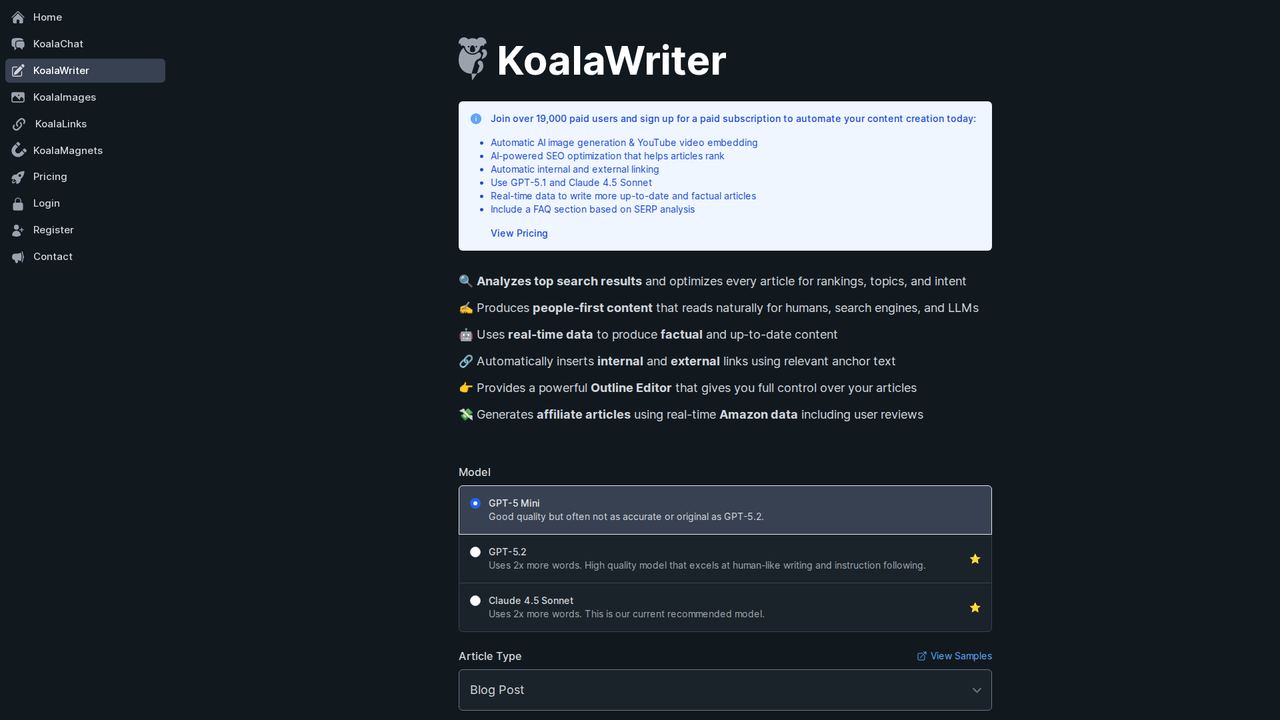
As of July 2026, Essentials starts at just $9/month for 15,000 words, and Professional, the most popular plan, is $49/month for 100,000 words plus deep research and automatic internal linking. Read the fine print before you commit: switching to a higher-quality model like GPT-5.2 or Claude 4.5 Sonnet costs twice as many words, so a 100,000-word plan can turn into 50,000 words in practice.
The honest catch: this is squarely a tool for niche sites, affiliate content, and high-volume blogs, not brand-sensitive corporate copy. User reviews consistently flag thin customer support, and like every AI writer on this list, its drafts still need a real editing pass before they're worth publishing under your name. KoalaWriter doesn't have its own listing on this site yet, so there's no in-depth review to link to here, just the honest read above.
Who Almost Made the Cut (and Why They Didn't)
A few tools got genuinely close. It's worth explaining why they landed just outside the seven instead of pretending they don't exist.
Jasper AI is a capable marketing-focused AI writer with its own SEO mode and brand-voice controls, and we've reviewed it in full separately. But at $39 to $69 a month, it mostly repackages what ChatGPT or Claude already do, without Surfer or Frase's real-SERP grounding built in. It didn't clearly beat either category leader it's competing with.
MarketMuse is the most powerful tool in this entire field for topical authority planning, mapping an entire site's content gaps at once rather than grading one page at a time. But it stopped publishing public prices after its 2024 acquisition by Siteimprove, every paid tier is demo-and-quote only now, and its free tier caps out at 100 queries and five briefs a month. Clearscope does similar single-page grading for a price you can actually see in advance.
Google Gemini is a genuinely good generalist, with a useful free tier and Google AI Pro at $19.99/month. It just never distinguished itself for SEO writing specifically: the same strengths as ChatGPT and Claude, the same "still needs a real optimizer" gap, no feature that earned it a slot over either.
Rank Math AI packs 40-plus AI micro-tools (meta descriptions, alt text, schema help) into the world's most popular free WordPress SEO plugin, which is genuinely useful. But it's tied to WordPress, it recently moved from a credits system to a murkier feature-based limit model, and it's really an on-page technical assistant, not a writing or drafting tool in its own right.
Quillbot and Wordtune are both excellent at the sentence level, tightening, paraphrasing, catching clunky grammar, and genuinely useful during the edit pass. Neither runs a full SEO workflow on its own. They're a polish step, not a stage of the pipeline the way the seven above are.
Writesonic, which we've also reviewed separately, has added real SEO and AI-visibility tooling in the last year. It's solid. It just lands in the same territory as Jasper and KoalaWriter without a clear enough edge to bump one of the seven above.
How the 7 Actually Fit Together
Here's the part nobody selling a single subscription will say: there's no single winner. Each of these seven does a different job, and most of them barely overlap.
Ideation and first draft? ChatGPT or Claude.
Turning keyword research into a brief? Frase.
Optimizing a draft against what's actually ranking? Surfer SEO or Clearscope, depending on who's writing.
Research and drafting in one cheap, SEO-native tool? KoalaWriter.
Checking whether any of it landed in an AI answer? The Semrush AI Toolkit.
Most real workflows land on two or three of these, not all seven. A solo blogger might run KoalaWriter alone. A small content team might pair Claude for drafting with Surfer for optimization and check Semrush's AI Toolkit once a month. There's no prize for subscribing to everything on this list at once.
The one step none of these tools can do for you: deciding whether the page should exist in the first place. That part is still, stubbornly, your job.
Final Verdict
A year of testing narrowed a long list down to seven, and the honest pattern underneath all of them is the same one Google keeps repeating in its own guidance: the tool was never really the point. What it helps you produce, and how much judgment you still bring to it, is.
ChatGPT and Claude will draft faster than you can type. Frase and Surfer will show you exactly what a ranking page has that yours doesn't. Clearscope will grade it in language anyone can act on. KoalaWriter will run the whole loop cheaply if you're managing a niche site. And the Semrush AI Toolkit will finally tell you whether any of it showed up where readers, human or AI, actually look now.
None of them will decide what's worth writing about in the first place. That part's still yours. If the rest of your content operation runs on AI too, we've stress-tested AI website builders for SEO and AI image editors the same honest way.
GOT ANY QUESTIONS LEFT?
What is the best AI tool for SEO writing in 2026?
Can AI-written content still rank on Google in 2026?
Do I need a special AI SEO tool to appear in AI Overviews or Google AI Mode?
What is the cheapest AI tool for SEO content on this list?